
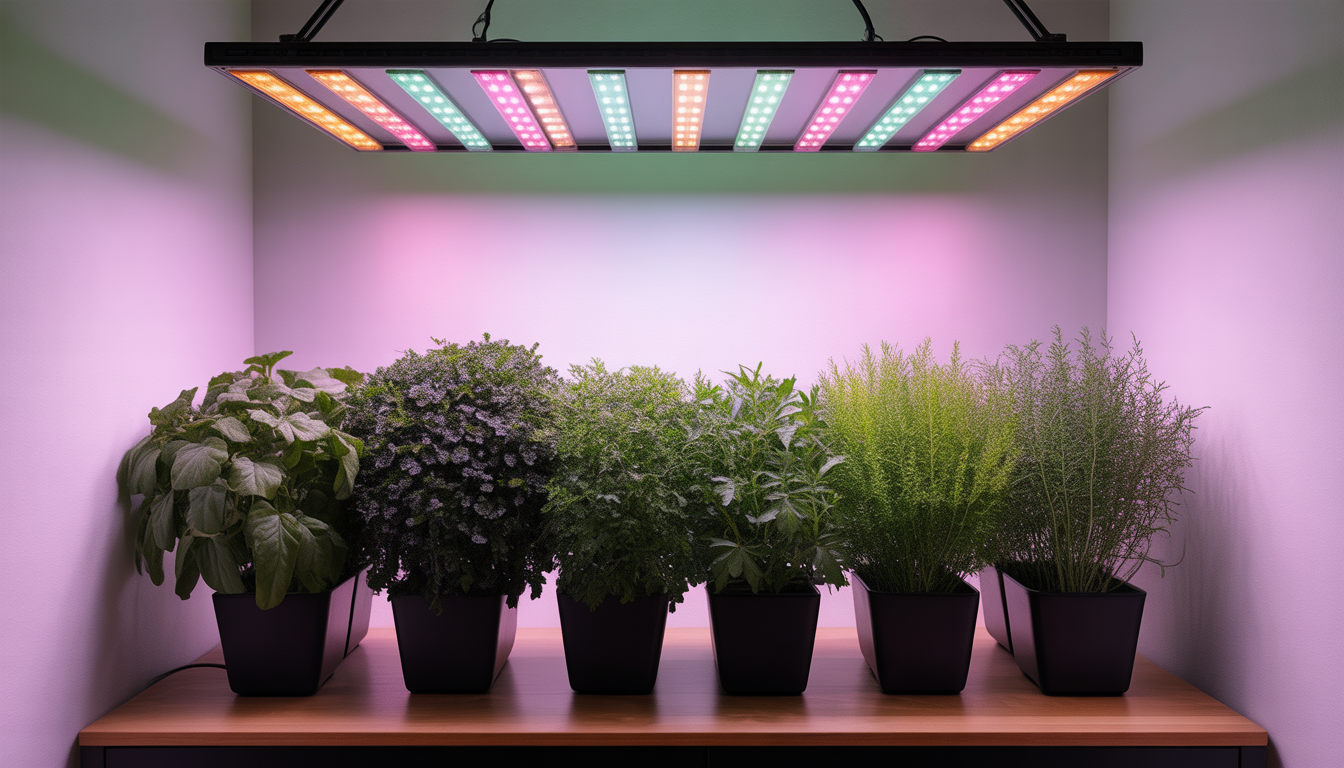
No matter what the weather is like outside, protecting your plants from harm is now easier than ever. From kitchen herbs to leafy greens and flowering plants, you can grow them all indoors. This is made possible by modern technology that allows us to provide artificial light for indoor plants. With this guide, you can learn how LED grow lights work in plant cultivation and the benefits they offer.
At the same time, you’ll be able to easily find a high-quality full-spectrum LED grow light that suits your plants’ needs. There’s no need to spend time searching elsewhere—below are the top products that can help keep your plants healthy.
Why Choose LED Grow Lights?
LED grow lights are an excellent solution for today’s indoor gardeners. When purchasing LED grow lights, you need to consider their durability—the construction must be high quality. Otherwise, you’ll be wasting your money. LED grow lights provide the light spectrum your plants need. If your plants don’t receive enough light, they won’t thrive, and their yield will decrease. Therefore, if you’re not harvesting many fruits and flowers from your indoor garden, you may want to use LED grow lights. They are also useful if you need to protect plants from snow or cold by providing sufficient daytime light.
Features & Benefits of LED Grow Lights
From professional gardeners to beginners, everyone can benefit greatly from grow lights.
You can use high-performance LED grow lights throughout all stages of cultivation (seed starting, vegetative growth, flowering, and fruiting). As a result, gardeners can use them for one or multiple purposes during the growing process.
If you notice yellow leaves and elongated stems, your plants may be suffering from insufficient light. You can use a grow light for that specific pot or for the entire garden.
In winter, grow lights can help your entire garden survive.
Grow lights allow you to start a garden in remote places where sunlight is scarce. You can even grow plants in a basement using these lights. They help keep plants healthy and disease-free. Factors such as fertilizer, watering, and temperature are all important for maintaining a healthy garden.
Grow lights can increase the yield of flowers, fruits, and seeds in your garden, ensuring maximum productivity each harvest season.
Grow lights or LED grow lights are very flexible in design and technology. They can be used as multi-tier vertical lighting systems, ceiling lights, or intercanopy lighting between plants. These lighting systems are commonly used in greenhouses and large-scale indoor gardens, and LEDs are the most suitable option for such setups.
Another advantage of LED lights is that they emit less heat and have higher lighting efficiency. Excessive heat is harmful to plants, slowing growth and potentially causing plant death. LEDs are more efficient at producing strong light while generating minimal heat.
Unlike sunlight, LED grow lights do not cause water to evaporate from the soil. Therefore, you don’t need to water your plants as frequently during the day.
SAMPHON 600W LED Grow Light Bar

Pros:
- Includes a timer to save energy
- Ideal for growing all indoor plants even on hydroponics
- Operates with a quiet cooling fan with 20-30% speed
- Helps boost the plants’ defense mechanism with an expensive IR UV lamp
- Perfect for winter with warm white light
Cons:
- Not powerful enough to help tomato plants grow tall and healthy
- Too bright to be looked at directly without an eye protection
See details and prices on Amazon here
GroCruiser 600W Dimmable Grow Light LED
Pros:
- Specially designed to replace 1,000W HID LEDs
- Provides a full spectrum to ensure your plants’ growth
- Includes dimmable power supply for convenience
- Offers bigger coverage for grow tents
Cons:
- The lamp gets too hot after using it for a couple of hours
- The wiring underneath it is exposed and hazardous
See details and prices on Amazon here
How to Choose?
Today, LED lights are widely used by growers all over the world, and many different versions are available on the market. Rather than persuading you to buy from a single brand, we leave the final decision up to you. Below are some tips and key questions to help you choose the right LED grow light.
Look for the Right Chips
To ensure healthy plant growth, an LED grow light must use suitable chips. In this case, you should choose LED grow lights with chips rated at at least 3 watts. Any LED chip below 3 watts will not provide enough light for proper plant development. Therefore, each chip in the LED light should be 3 watts, as 3-watt chips offer the best lighting solution.
You’ll often see this in blue, red, and white LEDs, so be cautious of lights that provide only 1 watt per chip. Using three 1-watt chips to meet this requirement is also ineffective.
Check the Total Wattage
As with any lighting solution, you should check the product description to find out the total wattage. Also check the total number of units in the light, as this can affect how much light it produces. Some LED grow lights are built with 300W, 400W, 600W, or even 1,000W. Before heading to the checkout, make sure it has at least 300W. The higher the wattage, the better, as it helps compensate for power loss over time.
Consider the Light Spectrum
Plants can grow under different types of light, but they require specific wavelengths and spectra to support photosynthesis. The best LED grow lights for indoor plants can provide the full spectrum needed for healthy growth.
In this case, the light should be able to deliver sufficient blue and red light, as well as ultraviolet (UV) and infrared (IR) rays. Depending on the plant’s growth stage, the required spectrum may change to better support photosynthesis.
Consider Cooling Features
Generally, LEDs generate less heat, so a cooling system may not be strictly necessary for some models. However, since you’ll be running the lights for more than 10 hours a day, it’s best to check their cooling features. Some lights include built-in fans to prevent the fixture from overheating and to protect your plants. The heat released from the back of the light needs to be managed with proper cooling to prevent damage to the LED chips.
Growing Space
If LED lights come in different color configurations, they also come in different sizes. Be sure to measure your growing space to determine the correct size to purchase. You should also calculate the coverage area to ensure all your plants receive adequate light. For high-light plants, you should use LED lights with at least 32W/m², while low-light plants should use lights rated at around 11–18W/m².
Ease of Use
One of the most important factors when choosing an LED grow light is ease of use. The best LED grow lights for indoor gardening should be simple to operate. They should be flexible enough to adjust the light according to the type of plant you’re growing. At the same time, the plant’s growth stage will determine the optimal placement of the LED light.
Conclusion
The best LED grow lights are ideal for indoor plants if you want to grow fruits, flowers, and vegetables. Today, large commercial operations use LED lighting technology to achieve high yields, as it allows them to control plant growth, flowering, and fruit production indoors.
Here, we have reviewed only LED lighting systems suitable for indoor use. The same applies to both small and large indoor gardens, as LED lighting enables you to manage your garden efficiently. Today, people can grow a wide variety of plants and herbs that they previously never imagined growing in outdoor gardens.
See more: Best Cheap LED Grow Lights For Indoor Plants