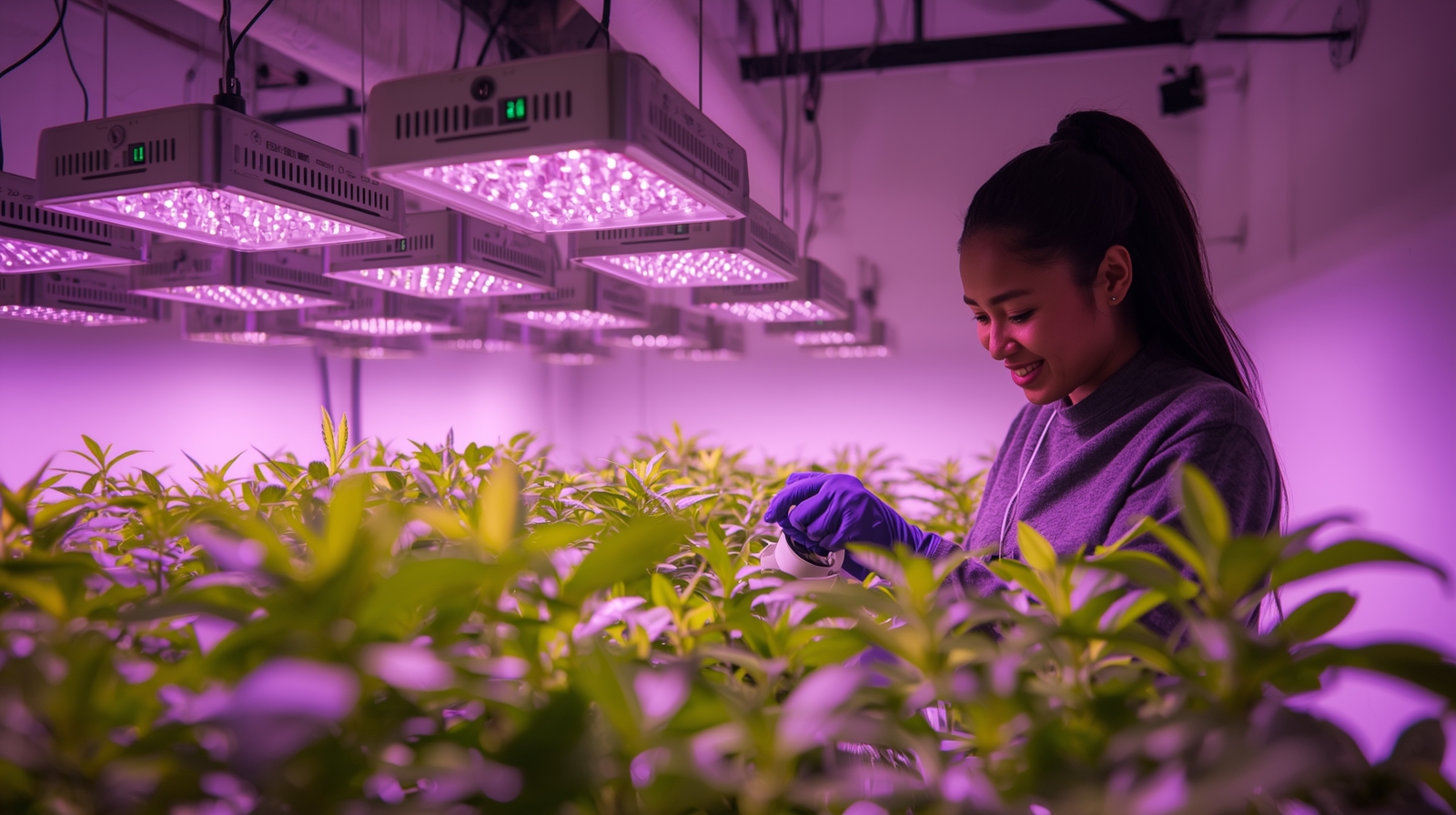
Are you looking for LED grow lights? Having the right grow light in your system can be one of the most important things you need to ensure. Plants can thrive when they receive all the essential nutrients, are equipped with the most advanced hydroponic technology, and have an airflow system that keeps them cool and full of oxygen but without light, all of that becomes meaningless, or even impossible. That’s why LED grow lights are so important.
However, finding the best LED grow light is not simple, which is why we’ve put together this document, a comprehensive guide to help you find the grow light that best fits your needs.
The Top 5 LED Grow Lights For The Money
 Model: Phlizon Upgraded
Wattage: 1000 Watt
Coverage Area: 4 sq.ft
Support: 3 Years Hassle-Free Warranty
|
 Model: Phlizon pro2000W
Wattage: 2000 Watt
Coverage Area: 8 sq.ft
Support: 3 Years Hassle-Free Warranty
|
 Model: LUYIMIN
Wattage: 200W
Lifetime: 50,000 hours
Support: 5 Years Warranty
|
 Model: Diamond Series XML 150 USA
Wattage: 232W
Coverage Area: 3 sq.ft
Support: 3 Years Warranty
|
 Model: KingLED KP1000
Wattage: 1000 Watt
Coverage Area: 4 sq.ft
Support: 3 Years Warranty
|
Click here to find out more about buying LED Grow Lights online
LED Grow Lights
What Are LED Grow Lights?
LED grow lights are the latest mass-produced type of lighting on the market, although many people still haven’t begun using them. Since tiny LED bulbs may not be the first thing that comes to mind when you imagine an indoor growing area, this is understandable. However, in reality, they are actually one of the most powerful, efficient, and space-saving types of grow lights you will come across throughout your growing journey.
LEDs have a long history of use in many different applications. Since they were first used as indicator lights in electronic devices, LEDs have increasingly established their importance in the modern world.
For indoor growers, LED lights are very appealing. Before LED technology reached the level it has today, growers mainly used them for supplemental lighting. A grower could use HID grow lights throughout various growth stages, and for plants needing extra light or more energy during flowering, they would install additional LED panels in specific positions because they were so easy to set up without taking up much space. However, today there are far more powerful and much larger LED panels capable of providing intense light across an entire grow area, keeping your plants healthy and productive.
Other lighting systems require ballasts and large cooling systems, but LEDs are completely self-contained. A single panel—whether round, square, or in many other shapes—only needs to be hung above the plants. The size of your grow area will determine the panel size, but all of them contain arrays of small LED diodes.
Benefits
What Are the Benefits of Using LED Grow Lights?
There are countless benefits to using LED lights. We will compare these benefits with other types of lights previously used, but first, an overview will help you see what advantages you can expect.
Space-Saving Design
While other grow light types require plenty of space and often need extra equipment to operate, LED grow lights free up room in your grow area. Their relatively compact size allows you to move around your grow room more easily because you won’t have to deal with additional devices and bulky cooling systems. The easier it is to access your plants, the better you can take care of them.
Low Operating Temperature
Temperature is extremely important in a grow room. Without close attention to temperature, you risk losing your entire crop. Even with proper monitoring, large cooling systems are often required to keep the room cool. LED grow lights have the advantage of operating at a temperature that is only warm to the touch, instead of reaching 200 or even 130 degrees Celsius.
Energy Efficiency
Traditional indoor grow lighting can be very powerful, but unfortunately not energy-efficient. That’s why LED grow lights are popular—they can produce a high amount of light without consuming excessive electricity. This saves you money in the long run.
Long Lifespan
When using high-quality LED grow lights, you may be able to grow for many years without needing to replace your lighting system. Most LED lights have a lifespan of 50,000 to 100,000 hours. In comparison, many other grow light types typically last around 20,000 hours before they need to be replaced.
Do LED Grow Lights Work?
How Do LED Grow Lights Work?
LED grow lights work by sending an electric current through a semiconductor material. This stimulates electrons to produce a strong light from a very small diode. By using different semiconductor materials, it is possible to create LED diodes with different light wavelengths. This allows them to provide exactly what indoor plants need at each stage of growth. How to use them will be discussed later.
What You Need to Know About Wattage
Best LED Grow Lights Reviews
It’s important to note that the wattage listed on the product may not be as accurate as you expect. Even though a light may be labeled with a certain wattage, you need to know how many watts the light actually consumes during operation.
For example, if you have a grow light labeled as 1000 watts by the manufacturer, that is the maximum power it could use. If you try to run the light at that full wattage, you may cause heat issues and actually shorten the lifespan of the LEDs. Under normal conditions, the same “1000-watt” grow light may be marketed as consuming anywhere from 300 watts to 1000 watts.
Always consider the actual power consumption, rather than the wattage advertised by the manufacturer.
What You Should Know About Light Wavelengths
The LED grow light you use in your grow room must provide the plants with the light they need. In nature, plants receive sunlight that spans a wide range of wavelengths—from ultraviolet light, which humans cannot see, to infrared light, which is also invisible to us. In between are violet, blue, green, yellow, orange, and red. Depending on the plant type and its growth cycle, different parts of the spectrum will be important.
About Light Wavelengths
What Are Full-Spectrum LED Grow Lights?
Outdoor plants have many advantages compared to indoor plants, mainly because they benefit from sunlight, which provides the full spectrum of visible light. To give your plants everything they need—light for both the vegetative and flowering stages—you will need a full-spectrum LED grow light.
HPS and fluorescent lights have been used for many years in indoor growing, and many people still rely on them. Their extremely strong light output—including wavelengths across the spectrum—offers a major advantage, though it comes at a cost. As a result, many growers switched to LEDs, but some overlooked the importance of providing the full spectrum needed throughout a plant’s natural life cycle.
Many people make the mistake of using only one type of LED grow light. This cannot provide plants with everything they need for both growth stages. In contrast, full-spectrum LED grow lights provide a wide range of blue, red, white, and ultraviolet light.
Full-spectrum LED grow lights involve many factors, including different ratios of the various colors your plants require—but we will cover that later. Understanding the benefits of each type of LED light will help you take full control of your grow and ensure better results than ever before.
Colors of the Light Spectrum
Natural sunlight contains the full spectrum of light. When manufacturing LED panels, producers use only certain types of LEDs, each emitting a specific color, to supply the essential “nutrients” that plants need. Here, we’ll look at the different colors, including the best combination for your growing operation.
- Blue. Blue LEDs, in the 400nm wavelength range, are ideal for vegetative growth, promoting tall, leafy plants. However, during flowering and budding stages, blue light is not very useful and may cause plants to become bushy without producing many buds.
- Red. In contrast to blue light, red LEDs in the 600–640nm wavelength range help stimulate budding and flowering. Just as blue light does little for flowering, too much red light does not support healthy vegetative growth.
- White. White LEDs are controversial among growers, but at the very least, they make it easier to see inside the grow room. If your system includes only red and blue LEDs, identifying and troubleshooting issues becomes nearly impossible. There is also much debate surrounding the spectrum balance they provide.
- Ultraviolet. UV light is not used in all LED grow systems, but it can be worth experimenting with. The idea originally came from growers who noticed that equatorial cannabis strains had much higher potency, despite being exposed to the most “harmful” rays. Research has shown that short-term exposure to UV can be beneficial when trying to increase THC production.
The Right Combination
Ensuring proper plant growth and health means providing a suitable mix of light. Outdoor plants naturally enjoy a wide range of wavelengths, but recreating this indoors is relatively simple.
For an optimal color ratio, your lighting should include the following proportions. As long as you stay close to these percentages, you’ll be fine:
- 55% red LEDs at 660nm
- 20% red LEDs at 630nm
- 15% blue LEDs at 470nm
- 10% blue LEDs at 425nm
Why Are LED Grow Lights With Only Red and Blue Often Ineffective?
Many growers use just one set of red LEDs and one set of blue LEDs. The problem is that this setup cannot provide the full range of light that plants naturally receive outdoors. In nature, the type of light plants get varies and shifts across days and months. Recreating these light conditions indoors is crucial for a successful harvest. Research thoroughly and avoid excluding beneficial wavelengths.
About Light Cycles
What You Need to Know About Light Cycles
The current light cycle of your plants will determine the type of light you use and how many hours the lights stay on each day. Understanding this is essential if you want the highest chance of success.
In natural outdoor growing, plants receive plenty of light during the early growing season. As the months pass and autumn arrives, the days shorten and nighttime increases. When growing indoors, these conditions must be recreated artificially.
Spending more time in the vegetative stage results in larger overall plant size—which can be a problem when growing indoors. In theory, a plant can remain in the vegetative stage indefinitely. This allows you to create what is known as a “mother plant.” Mother plants can be cloned repeatedly, saving time by starting with cuttings instead of seeds. This also means you can reproduce exact copies of your favorite plant from your harvest.
The flowering stage is more delicate. Spending too much time in this stage leads to poor flowering, making it the more “practical” stage of cultivation.
Light Cycles for Cannabis
To grow cannabis, it is crucial to provide the proper amount of light and darkness each day to stimulate the right development in both the vegetative and flowering stages, while also ensuring proper THC production.
Vegetative Growth
The vegetative growth cycle is the stage where you save on electricity costs because the plants do not require extremely strong light. The most important thing during this stage is to provide stable, uniform LED lighting over long periods.
During the vegetative stage, your cannabis plants need 16 to 18 hours of light per day. Depending on your cultivation method, the lighting period may be longer to support techniques such as the Screen of Green (ScrOG), which require extra growth. With this amount of light, plants will develop strong roots and sturdy main stems, supporting buds and producing plenty of foliage, including the famous five-fingered leaves.
This is also a critical stage regarding light wavelength, as you must ensure healthy leaves and stems. This is where carbon dioxide and light are converted into food through photosynthesis.
The blue light discussed earlier is used during this stage. In the 400–500nm range, plants activate photosynthesis and phototropism. Phototropism, triggered only by blue light, helps plants detect the direction of incoming light. Red light also contributes to photosynthesis, which is why full-spectrum LED grow lights are ideal.
Typically, this stage lasts four to six weeks under proper lighting. When plants begin to show the “pre-flowering” stage, they are ready to start budding whenever you are satisfied with their size.
Flowering
This is the stage you have been waiting for. Previously, LED lights provided blue light for 18 hours per day, but now the light schedule changes as the plants prepare to bud, giving you the results you expect.
The flowering stage uses 12 hours of light followed by 12 hours of darkness. This is when your plants begin to show their sex and start forming buds. During the first two weeks, you can identify male and female plants, which is essential if you want to remove males to prevent breeding. The flowering stage continues with the same light cycle until harvest time.
Simply changing the light cycle can convince your plants to start budding, but adding red light significantly improves this process. It’s still recommended to include some blue light as well, as it is generally beneficial for photosynthesis.
Note that LED grow lights cause your plants to use fewer nutrients. It’s easy to over-fertilize because you may be accustomed to using stronger lights, which can add stress to the plants.
Why Use LED Lights?
It may seem that any type of light can help plants grow, as long as it is turned on for the appropriate amount of time. That might be true, but LEDs trigger a special response inside the plant. LED lights are designed to target the parts of the plant responsible for initiating photosynthesis. This laser-like targeting almost acts like a cheat code for your indoor grow. You can bypass issues such as excessive heat and wasted light while immediately entering the perfect growth cycle, resulting in abundant harvests time and time again.
Automation
Although LEDs turn on instantly and do not require a warm-up period, it is important that this process be automated, rather than manually switching lights on and off. Many timers are available to handle this for you. Simply choose a timer and set the appropriate light and dark periods, and you’ll be ready.
However, make every effort to avoid entering the grow room during dark periods. Plants require complete darkness during “off” hours, which is easier to achieve if you don’t enter the room. Ensure the room is well-sealed for the best results.
Do You Need the Best LED Lights?
Why is having the best LED grow lights so important?
Installing LED grow lights is crucial for many reasons. There are numerous ways to provide light to plants, but how do you know which method is most efficient? How can you be sure that you’re not overheating plants while trying to provide extra light to increase yield?
The fact is, LEDs are the most efficient grow lights available on the market today. First, LED grow lights use over 75% less energy compared to traditional grow lights. By consuming less electricity, you save on utility bills and have more money to enjoy the fruits of your labor rather than spending most of it just to power your grow system.
Another important point is that the best LED grow lights use specific wavelengths that plants need most. Traditional grow lights over-illuminate plants, wasting most of the light. In contrast, LEDs use primarily blue and red wavelengths to give plants exactly what they need without wasting electricity or light on ineffective areas. Some LEDs include both wavelengths or just one, allowing you to customize and fine-tune the light to your plants’ needs.
LED grow lights are also much cooler, partly due to reduced energy consumption. Many traditional grow lights produce excessive heat, requiring additional cooling equipment. The hotter your grow room, the more you must circulate air and constantly monitor temperature.
This also makes LED grow lights much more environmentally friendly. With increasing concern over environmental issues, global warming, and the planet’s future, it’s easy to understand why people prefer eco-friendly options. LEDs reduce CO2 emissions significantly, along with saving electricity, benefiting the environment. Unlike HPS lights, which contain mercury and require special disposal after a few years, LED grow lights are long-lasting and can be safely discarded after nearly a decade without environmental harm.
Finally, LEDs do not need frequent replacement. Many traditional grow lights wear out quickly and need to be replaced often. In contrast, most high-quality LED grow lights last over 50,000 hours, meaning they only need replacement after 7–8 years. While upfront costs may seem high, considering their lifespan, the long-term savings are substantial.
LED vs. HPS Lights
LED Grow Lights vs. HPS Lights
HPS lights are one of the most commonly used indoor grow lighting systems today. HPS stands for High Pressure Sodium, and these lights primarily emit yellow-wavelength light. They are also much cheaper than other grow lights, such as LEDs or T5 lights. However, HPS lighting systems still come with many issues.
HPS systems are more efficient than older lighting systems, but they are not the best. By combining certain gases, an electric current passes through and charges an arc tube made of aluminum oxide. This arc produces extremely bright and powerful light, but it also comes with drawbacks that can cause problems for most growers.
HPS grow lights generate a large amount of heat and require significant electricity to operate efficiently. While they can work well if properly controlled and don’t require high initial costs, they can quickly become problematic over time. The yellow light they produce is also not very effective during either the vegetative or flowering stages.
Another issue with HPS lights is their high CO2 emissions. As environmental awareness increases, this has become an important factor in deciding which lighting to choose. These lights also require safe disposal, as they contain mercury and can be harmful to the environment even when no longer in use.
Compared to LEDs, LED lights not only eliminate wasted yellow light but also use more efficient wavelengths that provide real benefits for your plants. They do not have the energy issues of HPS systems, making them cheaper to operate. While initially more expensive than HPS lights, the long-term savings can make a significant difference in your profits per harvest.
LED vs. HID Lights
LED Grow Lights vs. HID Lights
In terms of initial setup cost, HID lights (High-Intensity Discharge) are a very affordable option for indoor growers. However, over time, this initial savings may be offset by additional operational costs.
HID lights work by sending an electric current through a metal vapor, energizing electrons and causing them to collide, producing light. This process takes a few seconds, and within about half a minute, the light reaches full power. If turned off before it warms up, it must cool completely before being turned on again. This can lead to significant electricity consumption, although many growers continue to rely on HID systems.
The reason many growers switch to LED lights is that LEDs are efficient in every aspect. They are designed to emit only the appropriate red and blue light spectrum, promoting both flowering and vegetative growth, allowing plants to reach high yields without high costs.
In contrast, HID lights do not meet these criteria. While HID lights are very bright and powerful, they produce a lot of heat and require continuous air circulation and cooling. This also means higher operating costs, which can become very expensive if used daily. HID lights can support plant growth at any stage of the life cycle, but they are costly and require special attention and maintenance.
LED vs. Fluorescent Lights
LED vs. Fluorescent Lights
Fluorescent lights are popular because they emit relatively low heat compared to HID systems. However, they cannot compete with LEDs. In fact, many people using fluorescent lights end up adding LEDs to ensure their plants receive sufficient light.
Fluorescent lights use mercury vapor along with neon, xenon, argon, or krypton under pressure inside the tube. This creates environmental concerns, as they are not eco-friendly and must be disposed of safely if you are environmentally conscious.
They are inexpensive, easy to operate, and easy to replace, although they do not save on initial costs or electricity like LEDs. In this respect, LEDs clearly outperform fluorescent lights. If you want something cooler than traditional lighting systems, fluorescent lights could be an option, though not the best one.
LED vs. Plasma Lights
LED Grow Lights vs. Plasma Lights
Plasma grow lights are often considered one of the most technologically advanced types of grow lights on the market, but they are also the most expensive. This type of light does not use electrodes or filaments like traditional lighting systems. In fact, they offer many benefits compared to most other grow lights.
Although expensive, plasma lights are extremely powerful and efficient. They provide the same light spectrum as fluorescent and HPS lights, with impressive efficiency and space savings compared to lights that require ballasts and long wiring.
However, compared to LED grow lights, plasma lights are much larger, although still smaller than large HID systems. Their performance can surpass that of LED grow lights, but a single plasma grow light can cost over $3,000. Only the most advanced growers tend to switch to plasma lights, while most stick with reliable LEDs that achieve similar results.
T5 Lights vs. LED Bulbs
T5 Grow Lights with LED Bulbs
T5 LED grow lights are one of the biggest innovations in fluorescent technology. They offer many advantages over older T8 and T12 fluorescent lights, but many people want to switch to LEDs without completely replacing their lighting systems. T5 LED grow lights are a perfect solution for this.
Basically, T5 grow lights have a diameter of 5/8 inch (13.5 cm) and contain a gas that emits light when an electric current passes through. In this case, the same-sized tube is replaced with a narrow LED panel. Tubes that normally use around 50 watts now only consume about 20 watts while achieving similar effectiveness. You also gain the other benefits of LEDs, although they are slightly more expensive than T5s.
An additional benefit is that you can use much larger panels in your grow area. For larger operations, hanging many smaller LED panels of 30–60 cm in length can be cumbersome. With T5 LED lights, options up to 1.2 meters are available, covering a much larger area than standard LEDs and simplifying the number of hanging fixtures in your grow room.
T5 LED grow lights may not be the ideal choice for every grower, but they are a high-quality option that simplifies things while allowing you to use some of the best technology available.
Grow Lights Characteristics Comparison Table
LED Bulbs
LED Grow Bulbs
Know how to replace them. Many LED panels you use will have up to 100 individual LEDs or more. Some bulbs may fail over time, so it’s important to know how to replace them. Some are soldered in place, mostly those manufactured in China, but most of the latest LED panels allow bulbs to be replaced just like any other light bulb.
Choose the right colors. You’ve already learned about which colors to use, but if you become a professional grower, you can start selecting color ratios more selectively. The better you understand the growing process, the more you can adjust your color choices to suit the needs of your plants.
Don’t overuse the bulbs. LEDs can operate for up to 100,000 hours, but their lifespan can be significantly reduced if you try to push too much power through the device. In most cases, this isn’t a major concern, but it’s worth keeping in mind.
LED Grow Light Manufacturers
There are many LED grow light manufacturers on the market today, but some stand out as the top producers:
Advanced LED Grow Lights
Advanced LED has proven to be one of the best LED grow light manufacturers on the market. Their products outperform most other grow lights you might randomly find online. With years of experience in the grow light industry, they continually refine their products each year.
California LED
Professional LED grow lights are often extremely expensive. However, with California LED, you can find affordable, durable, and powerful options. After 13 years of manufacturing experience, they appear to have perfected the art of producing the best LED grow lights. Their SolarStorm and SolarFlare product lines are made in the USA, with all processes handled in-house. This dedicated approach ensures that every grow light meets the highest standards. With a focus on automation, efficiency, and power, California LED does the hard work for you.
Kind LED Grow Lights
Kind LED grow lights are high-quality for a very specific reason: they spent years researching and perfecting their products before officially launching. Initially skeptical about LED grow lights, these experienced growers decided they were ready to produce the best lights possible. Kind LEDs even developed a unique heat sink to significantly reduce heat, keeping them cooler than typical LED panels. With carefully researched products, top performance, and a 12-band spectrum, it’s hard to find a better option.
Spectrum King LED Grow Lights
Spectrum King LEDs are a unique choice in an increasingly competitive market. These grow lights can easily increase yields by 25%, reduce electricity bills by 50%, and occupy less space than many other LEDs, thanks to years of technical research. While they may not be the cheapest LED grow lights on the market, they are among the most efficient for larger, more profitable grows.
Dorm Grow (G8LED)
Dorm Grow is the exclusive distributor for G8LED lighting. G8LED lights are known as some of the best products in the industry, partly due to their combination of customer satisfaction, service, and strict quality standards. By focusing on customer needs, Dorm Grow understands what clients want and what causes dissatisfaction, creating high-quality products as a result.
They are confident that your plants will thrive so well that they offer a 90-day no-questions-asked return policy along with a two-year service warranty.
Hydro Grow
Hydro Grow prides itself on converting even the most technology-averse growers to LED innovations—a task that is never easy. Their lights may not be the cheapest on the market, but there is a very good reason: performance, reliability, and being among the most advanced grow lights you’ve ever seen.
Mars Hydro
Mars Hydro has been in the grow light industry since 2009. They have their own testing laboratories and continuously refine and improve their products every day. With years of experience and dedication, they are certainly worthy of being listed as one of the top LED grow light manufacturers.
TotalGrow
TotalGrow™ lights are inspired by the way plants actually absorb and use light. Using Solid-State Lighting Technology, TotalGrow™ produces a Broad Growth Spectrum at the wavelengths plants need most to grow quickly and healthily, while delivering industry-leading uniformity to enhance coverage and light penetration.
TaoTronics
Since its founding in 2008, TaoTronics has produced a wide range of lighting products, but their indoor LED grow lights truly shine. Over the past six years, they have provided products to millions of growers worldwide, many of whom return for repeat purchases. Research into consumer needs has guided them to create some of the top grow lights, capable of meeting every grower’s requirements. Their simple systems reduce stress and promote healthier plant growth.
LED Growing Tips
Indoor LED Growing Tips
- Use reflective lights. Depending on the LED option you choose, using reflectors to direct light exactly where you need it can be very helpful. Many lights are non-directional and require support.
- Monitor temperature. LED grow lights run much cooler than other options. However, this can sometimes be an issue, as your plants may get too cold. Add supplemental heat if necessary and always monitor temperature.
- Add LEDs as needed. For optimal results, you may want to add a blue LED panel on either side of your plants. This ensures light reaches all leaves, especially if you grow traditionally without SCROG or SOG techniques.
- Keep the proper distance. Maintaining the correct distance from LED lights will significantly improve your growing efficiency. LEDs can be placed closer than other types of grow lights, but you must ensure they are far enough to fully cover the canopy.
- Protect your investment. LED grow lights can be expensive, so take good care of them. Use a voltage stabilizer to regulate the power going into the lights. This keeps the voltage consistent and prevents damage from power surges.
Before You Buy…
Before You Buy
Now that you understand why the best LED grow lights are the most efficient way to grow plants indoors, it’s important to know exactly what to look for in a model before making a purchase. While LED grow lights generally consume less electricity, provide more useful light, and emit less heat, there are still low-quality models that may not meet all your needs. However, by keeping a few key points in mind, you can enjoy bountiful harvests, save money, and truly enjoy the fruits of your labor. And be sure to read our LED grow light reviews below to see which products are top-rated.
- Sturdy Construction. It goes without saying that using solid construction methods in LED grow light manufacturing is extremely important. If the best metals and wiring are not used, the light may perform poorly and generate extra heat, causing issues not only for your plants but also for the light itself. Improper heat dissipation can be very dangerous. When dealing with the amount of heat and energy needed for indoor growing, you cannot take risks.
- Red and Blue LEDs. For the most part, plants rely on red and blue spectrum light to grow through their two main growth stages. HPS and HID lights use the full spectrum and rely on lighting to help plants thrive. A good LED system will combine red and blue LEDs to create the perfect mix, supporting both vegetative growth and flowering.
- High-Quality Cooling System. Although LED grow lights are usually much cooler than HID and HPS systems, this doesn’t mean you should ignore the cooling system your lights use. Heat sinks are designed to draw heat away from the LEDs and dissipate it away from the grow area. Metal-core printed circuit boards (PCBs) are used to withstand extremely high temperatures and are attached to panels with “heat-dissipating fins” that transfer heat into the air. The more fins there are, the further the heat is moved away from your plants.
- Warranty. Warranties may seem less important for long-lasting LED grow lights, but that doesn’t mean you should blindly trust marketing claims. When reviewing a grow light, make sure to check the warranty. With the significant upfront investment required for LED grow lights, you cannot take risks. A good warranty should cover replacement and repair of components for at least five years after purchase. This saves you from paying out-of-pocket for any necessary repairs and ensures long-term savings. While LED grow lights are cost-effective over time, you must ensure you won’t face unexpected expenses after your purchase.
Pre-Purchase Checklist
- Budget. Your budget is one of the most important things to understand when starting indoor growing. Highly rated LED grow lights are often more expensive than other types of lights, such as HPS or HID systems. By understanding how much you can afford, you’ll be able to make the best decision for your growing setup.
- Grow Space Size. Both the height and area of your grow space are important when choosing an LED grow light, as you’ll need a light of a certain size to cover your existing space effectively.
- Growing Style. There are many popular growing styles in modern gardening. Depending on whether you’re growing shrubs, woody plants, greens, or bushes, you’ll need to select specific setups that provide the highest efficiency.
- Cooling System. Compared to other grow lights, LEDs run very cool. This can affect your growing process. If you already have a large cooling system installed, you might consider removing it to free up space. However, if you’re a beginner, you will still need some airflow systems, although not necessarily the large-scale cooling setups typically used to remove heat from 400-degree grow lights.
Light Footprint Size.
Many manufacturers provide a figure called the “core coverage area,” which is the grow space that the light can effectively cover. In general, follow these guidelines to ensure proper coverage:
- 2’ x 2’ grow space: One 180–240 watt light
- 2’ x 3’ grow space: One 300–400 watt light
- 2’ x 4’ grow space: Two 180–240 watt lights
- 4’ x 4’ grow space: Four 180–240 watt lights (or equivalent)
- 4’ x 6’ grow space: Three 300–400 watt lights (or equivalent)
Use these numbers to scale up your grow if you have a larger space. Remember, you must also position your grow lights correctly to avoid coverage gaps that could deprive plants of nutrients.
Questions to Ask the Company:
- How long is your product warranty?
- What is your return and refund process?
- How many employees does the company have?
- Does the company have scientists or horticultural experts?
- When can I expect to receive my grow lights?
- Does the company provide tracking codes for shipments?
- What are the details of this LED grow light (including actual wattage, chip type, recommended coverage area, height above plants, etc.)?
If you feel you need more information about anything, don’t hesitate to ask. They want to work with you, so they want to make sure you feel comfortable spending money on their product. For more information, you can read our Buying Guide here.
Click here to find out more about buying LED Grow Lights online
Top Rated LED Grow Lights
Best LED Grow Lights 2026 Reviews
With the information you have gained in this report it is possible to choose the best grow lights for your own operation, but overall there are a few options that are the absolute best. Take a look at these eight best LED Grow Lights and you are sure to have something that takes your indoor grow to the next level.
FAQ Section
Frequently Asked Questions
Q: How many lights do I need for an 8’x8′ grow tent?
A: The number of lights you need depends on the size and wattage of the fixtures. An 8’x8′ space can easily be illuminated by two to four LED panels if they are chosen carefully.
Q: How many watts do I need?
A: Depending on the size of your room, there are two different wattage figures you need to know. The first is the maximum rated wattage of the light, but you also need to know the actual power consumption.
The actual power draw of the light should be about 25 watts per square foot of grow area. This is based on a 50% efficiency increase compared to other HPS or HID systems.
Q: What benefits do LED grow lights offer?
A: LED grow lights are capable of:
- Saving on electricity costs.
- Having a lifespan of up to 100,000 hours, compared to 20,000 hours for fluorescent lights.
- Being only slightly warm to the touch.
- Providing plants with the exact amount of light they need without waste.
Q: What is the best LED grow light under $1,000?
A: For the best LED grow light, you won’t find a better option than the G8LED 600-watt grow light with infrared and ultraviolet spectrum. This versatile unit delivers exceptional light output for your plants and ensures they grow strong and achieve higher yields than ever before.
Q: What is the most powerful LED grow light?
A: For the most powerful LED on the market, look no further than the HydroGrow Sol 9 900-watt LED grow light. With a specially designed reflector and 900 watts of power, it can intensely illuminate your plants without the need for traditional grow light products.
Q: What is the difference between LED grow lights and other types of grow lights?
A: LED grow lights differ from fluorescent, HID, and HPS lights in that they represent a completely new technology in cultivation. With small, powerful, and energy-efficient diodes, you can achieve more than with the large, bulky, hot, and inefficient bulbs and tubes used in other systems.
Q: What is the best lighting distance for plants?
A: Ideal lighting distance is often discussed. HPS grow lights need to be placed farther away from plants to prevent leaf burn, but LED lights can be positioned much closer.
In fact, you can place LED lights as close to the plants as you like. However, for best results, you should keep the lights 16”–22” above the plant canopy.
Q: What is a light cycle?
A: A light cycle is the amount of time a plant is exposed to light each day. Indoor growing requires mimicking the natural environment, so your plants receive light for a set period each day before you turn off the LED lights. This typically means an 18-hours-on, 6-hours-off cycle during the vegetative stage, while a 12-hours-on, 12-hours-off cycle is used during the flowering stage.
Q: What is the maximum lifespan of LED grow lights?
A: The maximum lifespan of most LED grow lights is around 100,000 hours. Very few lights actually last that long, although most continue to perform well after 50,000–60,000 hours without any loss of power or efficiency.
Summary
Making The Decision
Choosing an LED grow light is a very important decision that many people often get wrong, but that doesn’t mean you will. The three lights listed here are all excellent options for virtually any indoor growing operation, at almost any scale. Knowing what to look for is the most important part, and now you can make the decision for yourself. With the best LED grow lights, you’ll be able to harvest more than ever before while keeping costs lower.
LED grow lights always have lower operating costs, provide all the necessary light spectrums, and produce the least amount of heat. Switching to LED grow lights is something very few growers regret.
Don’t judge each day by the harvest you reap but by the seeds that you plant.
Click here to find out more about buying LED Grow Lights online