
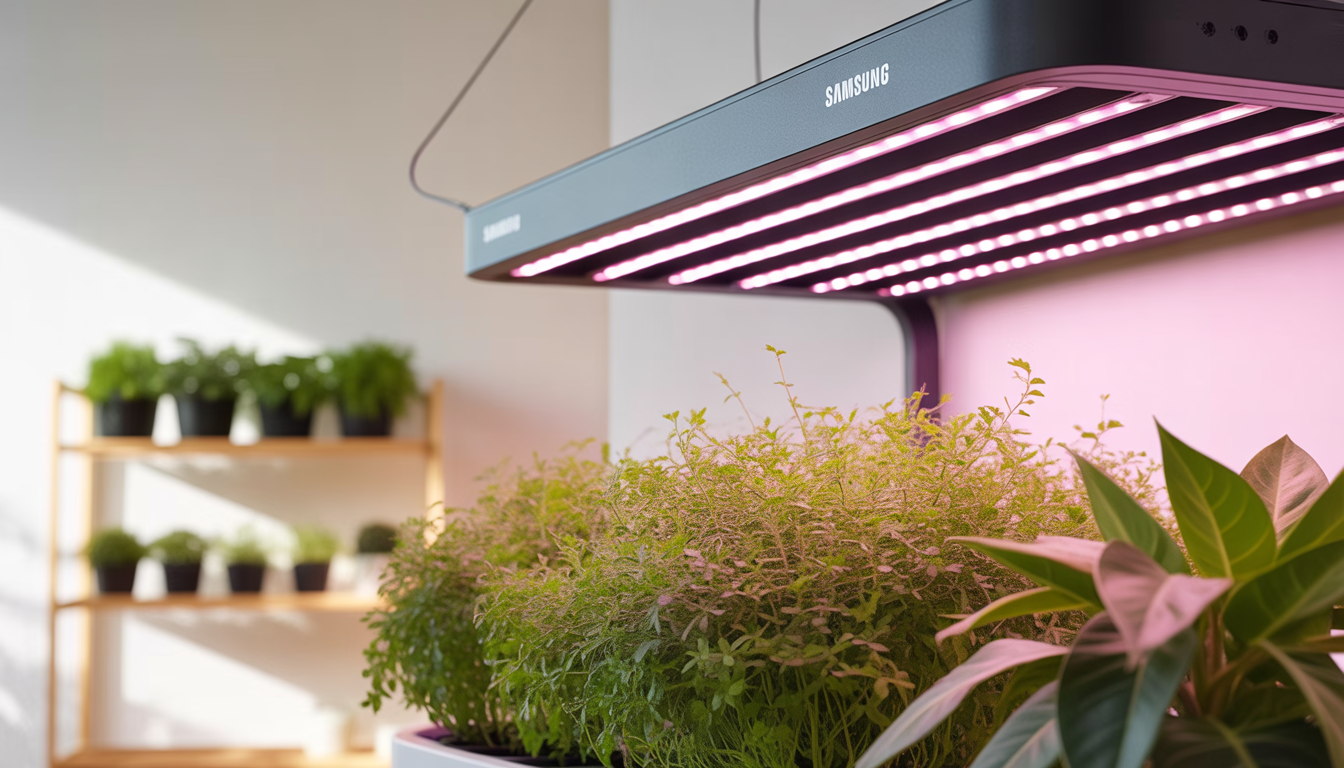
If you have an indoor growing system, you understand that you can’t rely solely on daylight to maximize plant health and yields. Samsung LED grow lights provide a wide range of light rays along with the visible spectrum and more to give your plants the best possible conditions for photosynthesis throughout their growth cycle.
What are the benefits of using LED grow lights?
Since LED bulbs were introduced to the market, consumer demand for them has continued to grow over time. In fact, most light bulbs and lighting fixtures sold today are LED. As a result, even today’s nature lovers who enjoy indoor gardening are finding ways to take advantage of these lights. Here are the top benefits of owning a high-quality LED grow light:
Energy efficiency
This is the number one advantage of LED grow lights over other types of lighting, as LED bulbs consume fewer watts. However, they can produce an amount of light comparable to high-intensity discharge (HID) lamps. Even with fewer bulbs, you can be sure that most of the energy used is converted into light rather than heat.
Unlike traditional lighting, LEDs do not burn anything to produce light. As a result, they use less energy and generate less heat, helping you save on electricity costs.
Environmentally friendly
As mentioned earlier, LED grow lights contain no mercury, gas, filaments, or other harmful substances like HID lamps. Instead, they are designed and manufactured using environmentally friendly materials that are 100% recyclable. Therefore, you don’t need to worry about harm to yourself or your plants from exposure to their light. To ensure this, the best LED grow lights typically carry RoHS certification to demonstrate their quality.
Faster harvest cycles
Unlike outdoor plants that rely on natural sunlight, indoor plants depend on artificial lighting from LEDs. These LED grow lights can be used for extended periods to help your plants grow faster and shorten harvest cycles. You can also adjust red light wavelengths at the right time to stimulate plant growth.
In addition, you can modify the lighting schedule of these bulbs, allowing you to harvest multiple times in a single season.
Healthier plants
Other types of artificial lighting emit excessive UV rays, infrared radiation, and heat, which can harm plants. With LED lighting, these excess factors are minimized, such as unnecessary blue and yellow wavelengths. As a result, your plants receive just the right amounts, helping them grow healthier and live longer. In fact, you can also fine-tune light wavelengths to support plants during photosynthesis.
Cooler operating temperatures
Compared to HID lights, LED grow lights generate much less heat and have minimal impact on overall indoor temperatures. This is especially true in greenhouses with multiple LED fixtures installed. As a result, you can save money by eliminating the need for cooling systems to keep your plants healthy.
LUYIMIN Upgrade 2000W LED Grow Light Samsung 301H LED Grow Light

Pros:
- Easy to set and to operate
- Offers a bloom and veg setting for convenience
- Produces low heat compared with other lighting solutions for indoor plants
- Promotes faster and bigger amount of yields with samsung 301h strip
- Energy-efficient and doesn’t need any extra ballast
Cons:
- Too bright to be looked at directly an eye protection
- Some units still emit a small amount of light even when turned off
See details and prices on Amazon here
FARMLITE LED Grow Lights

Pros:
- Offers a full spectrum with the latest white light technology
- Tested and proven to provide the highest yield on plants
- Produces 40% more light to the canopy with less 10W
Cons:
- Produces a little noise that comes from its fan
- The COBs gets too hot than necessary which can burn you
See details and prices on Amazon here
Phlizon 1500W LED Plant Grow Light

Pros:
- Certified with EC, ROHS, and UL listed
- Uses PWM dimming lights
- Provides an extra-large footprint that promotes better harvests
- Allows you to fully adjust its spectrum to match the needs of your flowers and vegetables
Cons:
- The deep penetration of spectrum is not that efficient for some plants
- The fan is a little bit noisy
See details and prices on Amazon here
KingLED KP1000 LED Grow Light

Pros:
- Produces high-quality plants with better taste and aroma
- Compatible with growing both flowering and vegetative plants
- Promotes the most efficient and highest ratio of yield
- Doesn’t require a ballast to operate
Cons:
- Too pricey compared with its competitors
- Does not come with a separate bloom and veg switch for convenience
See details and prices on Amazon here
VIPARSPECTRA Upgraded P4000 LED Grow Light

Pros:
- Patented with a compact design and powerful performance
- Packed with the best and the latest technology for boosting plants’ growth indoors
- Uses a lot less energy and produce less heat
- ETL, RoHS, CE, and FCC Certified
Cons:
- Too pricey
- Doesn’t allow you to adjust its single spectrum system for growth stages
- Can’t be placed too close to the plants
See details and prices on Amazon here
Key factors to consider when buying LED grow lights
Before choosing a full-spectrum LED grow light, consider the following important features:
Light spectrum
The light spectrum refers to the range of wavelengths produced by the lamp. Spectrum is essential for plant growth, helping plants grow larger and produce lush foliage and abundant fruit. Normally, plants receive their spectrum from sunlight, which enables photosynthesis. That is why spectrum is so important in agriculture and plant cultivation. Plants generally prefer yellow, orange, red, and blue light, and in some cases ultraviolet (UV) and infrared (IR) rays. Your LED grow light should include all of these spectra.
Light intensity
Another essential factor is light intensity, which helps plants grow healthy and vibrant. Therefore, choose a bright LED grow light to achieve lush green leaves and strong, thick branches. Insufficient light can cause plants to become weak and leggy, and may also turn leaves yellow.
Energy efficiency and power efficiency
LED grow lights are well known for producing high light output while consuming less electricity. However, some grow light systems can still increase your electricity bill. Therefore, choose a light that uses low power but provides strong illumination and wide coverage. Your LED grow light should be able to produce plenty of light without consuming excessive power.
Wattage affects plant growth in many ways. Of course, your overall horticultural knowledge and experience also matter. Wattage influences light intensity, temperature, and nutrient uptake. Low-cost, high-wattage LED grow lights may boost growth but can also raise overall garden temperatures—and your electricity costs.
Light lifespan
A good-quality light should have a long lifespan. People often assume that cheap lights have short lifespans while expensive ones last longer, but price alone does not determine durability. Therefore, check performance ratings and reviews from real users. Long lifespan and consistent performance are crucial for your plants, as the light will support them through all stages of growth.
Maintenance costs
Generally, LED lights do not require high maintenance. However, in some cases, low-cost lights may fail after just three or four days of use. Some models also rely on timers to control power switching. High-quality lights, on the other hand, can help you save on maintenance costs.
High-performance cooling system
Even the best grow lights can become hot, which is harmful to both plants and equipment. Therefore, maintaining low operating temperatures is essential for your indoor garden. Lights that operate at lower temperatures can care for your plants better than others.
Constant-current driver
An ideal LED circuit should provide a stable, continuous current. It adjusts output intensity as temperatures change. Grow lights with separate flowering and vegetative modes are especially effective at delivering the appropriate intensity based on plant needs.
Conclusion
LED grow lights are becoming increasingly popular in all types of indoor gardening. The best LED grow lights can help you grow strong, healthy plants that thrive. They can deliver high yields along with excellent fruit and flower quality. Indoor gardening offers many benefits the greatest one is also the most obvious: pests cannot attack your plants, and you have complete control over the weather.