
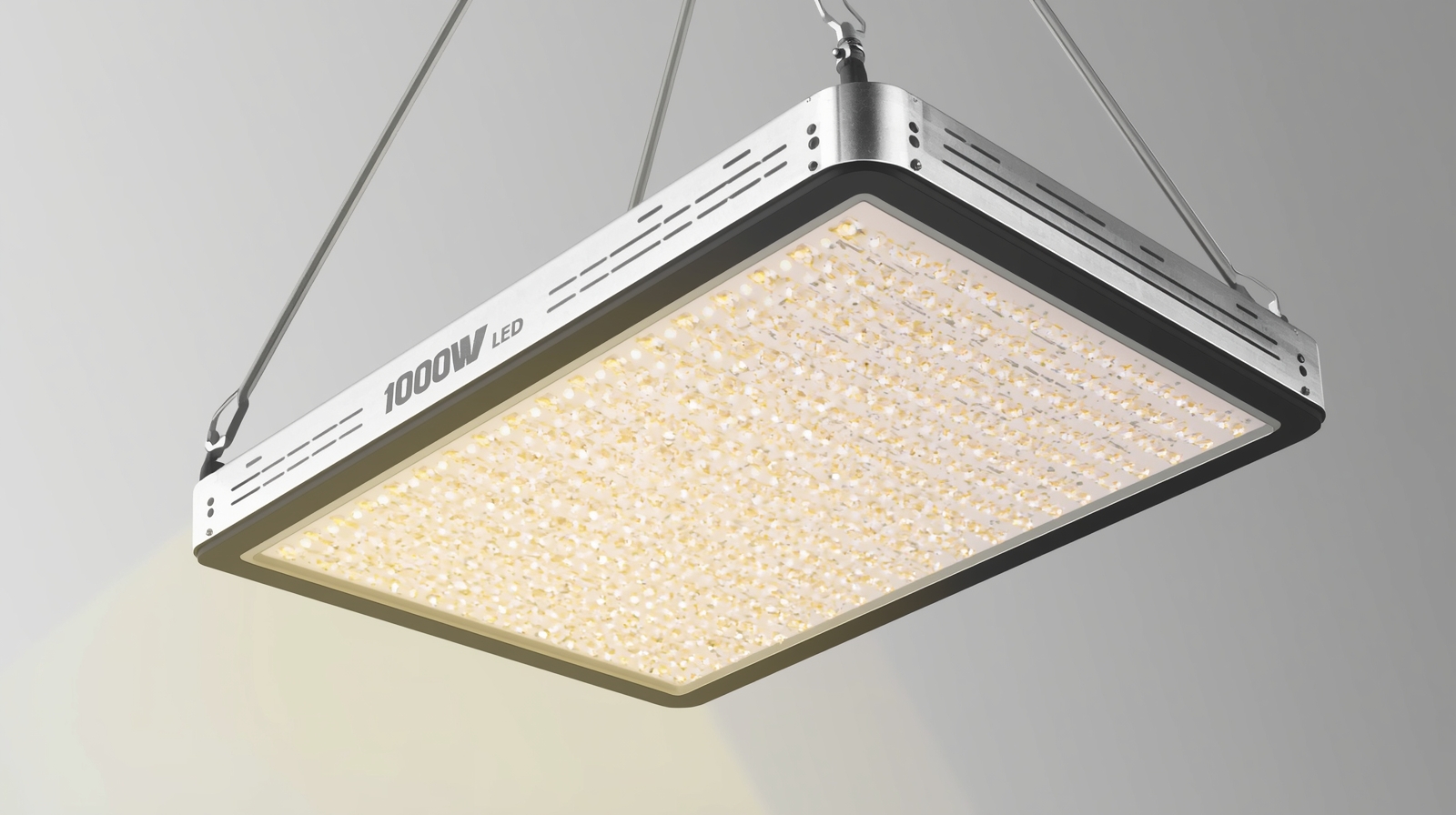
Grow lights are artificial lighting systems that help promote plant growth. They serve as an artificial light source that replaces sunlight. For example, during winter, the amount of available sunlight may not be sufficient for plants to grow properly.
Grow lights help plants absorb enough of the light spectrum required for photosynthesis. The spectrum they provide is similar to sunlight, or slightly less than what is needed for cultivation. Not all light spectrums are necessary for every plant or for producing fruit and flowers—this depends on the specific needs of the plant.
What Do I Need to Know Before Buying an LED Grow Light?
How to Choose the Best LED Grow Light: There are many important factors to consider. Below are the most critical ones.
Plant Requirements:
Light cycles can have a significant impact on a plant’s development and vitality. Some plants require full light from a high-intensity source, while others may wilt or suffer leaf burn if exposed to too much light. Make sure you understand your plants’ needs from the very beginning.
Full-spectrum LED grow lights help ensure maximum growth. Ideally, these lights should include both red and blue spectrums, as well as infrared and ultraviolet light. (If you are not growing from seed or starting seedlings outdoors, red and blue light alone may be sufficient, but full-spectrum lighting is always preferred.) Even better is the ability to control the light spectrum and the timing of its output.
Energy Efficiency
Full-spectrum LED grow lights are generally more energy-efficient. They are durable, usually run cool without the need for additional fans, and consume less electricity. Your grow light may need to operate up to 18 hours per day.
The higher the wattage output, the more electricity you consume—but not in a linear way. In other words, if you need 1,000 watts instead of 500 watts, you will not necessarily see double the power consumption.
Control and Customization
Keep in mind that you will change the lighting cycle depending on the growth stage to ensure optimal plant development:
- Seedling stage: 16 hours on / 8 hours off
- Vegetative stage: 18 hours on / 6 hours off
- Flowering stage: 12 hours on / 12 hours off
Grow Room Size and Spacing
Do not argue with the manufacturer’s specifications, especially regarding coverage area. Your LED grow light system only needs to cover the appropriate space for your plants.
Remember that if you are growing with a hydroponic system, you will need adequate power and water supplies for both the system and your lights. This may require additional planning in smaller spaces.
Also, if you are choosing a light that is not listed here, read reviews and feedback about the system’s actual coverage area. Sometimes there can be discrepancies in this regard, as discussed above.
Balancing Budget with Quality Equipment
This can be tricky, but it is clearly very important. High-end grow lights generally produce better results, but a budget is only effective if every component fits within it. New growers may want to choose a more affordable grow light to gain experience. More experienced growers who know what they like and what their plants need may opt for more expensive options.
LED grow lights are not the only components you need for an indoor growing operation. Your budget must also include fertilizers, filters, grow tents, soil, nutrients, and many other supplies. This means spending your entire budget on the best possible light may not be practical—but your goal should be to allocate as much of your budget as possible toward a quality LED grow light.
Since quality is the goal, brand reputation matters. In this field, the best brands build loyal customer bases and generate positive reviews. They also tend to address negative feedback. Look for this kind of brand strength online if you are unsure about a lighting system or are deciding between several strong options.
Kingled KP2000 LED Grow Light

Full-Spectrum Grow Light with Vegetative and Flowering Modes
Pros
- Full-spectrum light
- Passive cooling light bars allow for versatile applications
- Waterproof design
- Easy vertical and horizontal installation
- High-quality components and construction
Cons
- Dimming feature requires an additional adapter (not included)
- Expensive for home growing
See details and prices on Amazon here
HONORSEN 2000W Full-Spectrum LED Grow Light

3×4 ft Coverage Area, Remote Control, Dimmable Grow Light
Pros
- Top-tier LED chips
- Fully programmable
- Remote control
Cons
- Expensive (but worth it)
See details and prices on Amazon here
How Many LED Grow Lights Do I Need?
5,000 watts over an area of 1.5 m × 1.5 m is equivalent to natural sunlight. In other words, the sun produces extremely intense light, and it is very difficult to replicate that indoors. LED technology is currently the most suitable indoor lighting solution for this challenge.
Indoor plants love light and can tolerate relatively high light levels, so you need to balance factors such as light intensity and temperature with cost and the livability of the space, if applicable.
Typically, a 1,000-watt LED grow light is the minimum required for a 1.2 m × 1.2 m grow area. A 600-watt LED grow light is suitable for a 90 cm × 90 cm space.
However, technically speaking, you can use up to 4,000 watts over a 1.2 m × 2.4 m grow area—provided you are able to control the heat output. The room must not become so hot that it damages the plant canopy, so be sure to balance your cooling system with the number of lights and the amount of heat they generate.
Conclusion
The best indoor LED grow lights are specifically designed for indoor cultivation if you want to grow fruits, flowers, and vegetables. Today, large industries use LED lighting technology to achieve high yields. This is how they control the growth of crops, fruits, flowers, and indoor plants.
See more: Best Cheap LED Grow Lights For Indoor Plants