
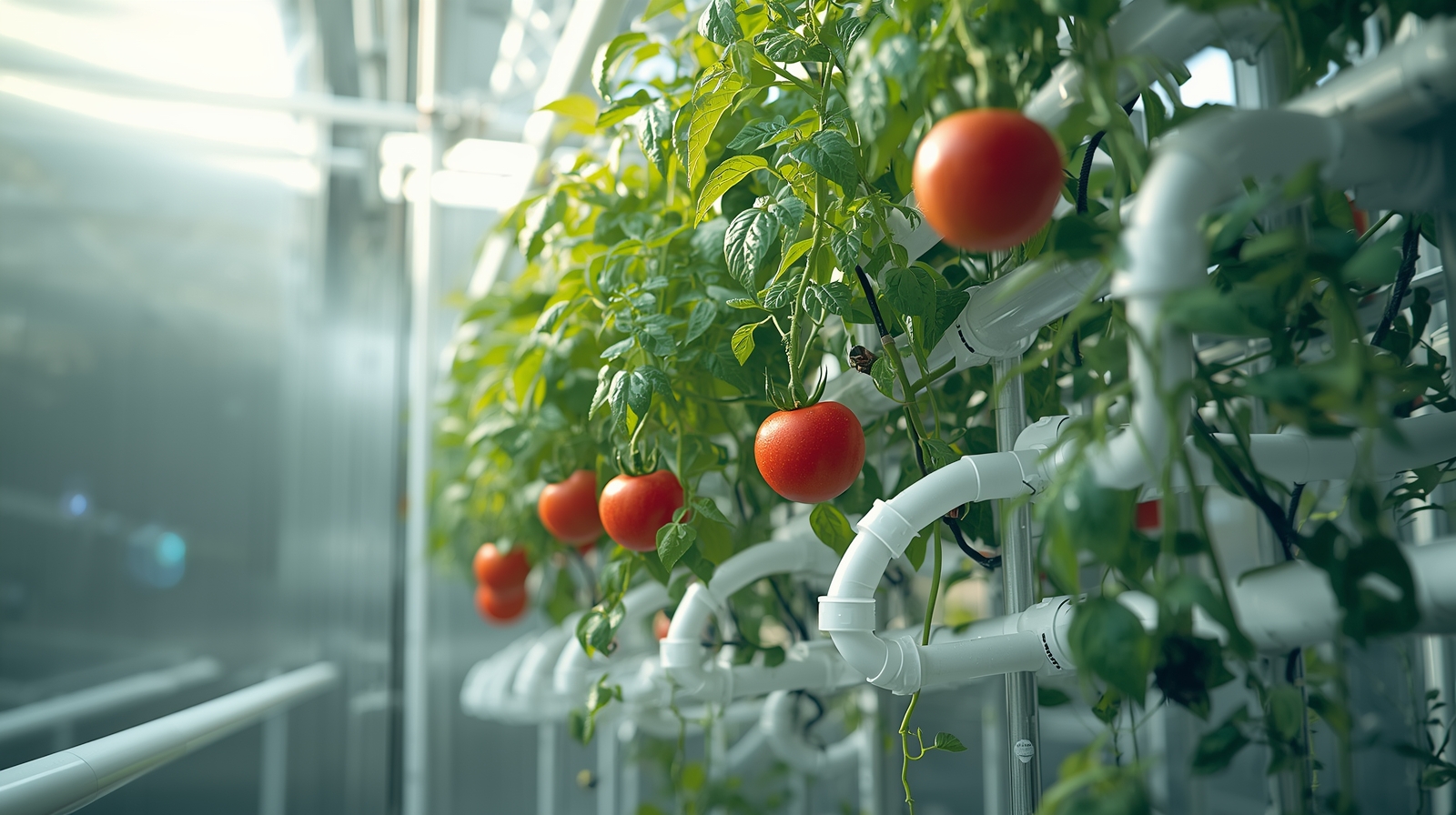
From pizza to burgers, salads, and sauces, tomatoes are one of the most popular home-grown foods. They come in a wide range of sizes, colors, and flavors. Tomatoes prefer moderate temperatures—not too hot and not too cold—making them ideal for indoor cultivation. They come in two main types: determinate and indeterminate. Determinate varieties form bushy plants suitable for smaller systems but produce fruit only once and then die. Indeterminate varieties spread or grow tall and require more staking, but if pruned after fruiting, they can produce another crop. This can make a significant difference when choosing varieties for your hydroponic setup.
Tomatoes can be propagated by sowing seeds in mineral wool blocks or by rooting cuttings taken from your existing tomato plants. Simply submerge the bottom 5 cm of a cutting in clean water until roots develop, then plant it. Because tomato varieties vary so widely, it’s difficult to predict exactly how long yours will take to mature, but the best average estimate is 60–80 days from the time they are transplanted into your hydroponic system. If possible, try staggering your harvests by starting new plants each month and replacing older ones to maintain continuous production.

Whether you are using a deep water culture system or a drip system, water-soluble fertilizers are dissolved into the reservoir to provide nutrients for the plants. In multi-step fertilizing schedules, each dose should be fully dissolved before adding the next. The pH and electrical conductivity of the nutrient solution should be checked regularly, at least 2–3 times per week, and adjusted if needed. Tomatoes require more calcium than many other crops, so be sure to include mineral supplements in your nutrient regimen. Your seedlings will need 12–18 hours of light per day.
Intermediate
| Stuff You’ll Need | |
| Tomato cuttings | 36L Clay Pebbles or Hydroton, rinsed |
A deep water culture hydroponic system like this uses an air pump to oxygenate the water. The roots grow down into the bottom of the bucket to absorb water and nutrients. Opaque buckets prevent algae growth. When you begin to see roots forming on the tomato cuttings, tear the Rockwool block in half vertically and fold it around the cutting. Place one cutting/block into each net pot and fill clay pebbles around it so that the growing media sits at least 2.5 cm below the rim.
Insert a 1.25 cm elbow fitting into the grommet hole at the bottom of the bucket. A 1.25 cm blue tube connects to the outside of the elbow and extends upward. After attaching the 1/4-inch tubing to the top of the blue tube, run the line to the air pump. Fill the Root Spa bucket with water and nutrients. Place the net pot into the bucket and check that the water level touches the roots but does not submerge the stem.
The air pump does not require a timer because it runs continuously. With the Root Spa, you can choose between 1-, 4-, or 8-bucket modules. When using multiple buckets, mixing the nutrient solution in a larger reservoir and filling each bucket from that source may make it easier to maintain consistency throughout the growing cycle.
Advanced
| Stuff You’ll Need | |
| Tomato sprouts/cuttings | Drip System |
| Clay Pebbles or Hydroton, rinsed |
As a pre-built drip irrigation system, the WaterFarm Controller uses an air pump to deliver a continuous, nutrient-rich drip directly to the tomato plant root zone. This system reduces the time needed to monitor pH and EC because it uses a single reservoir rather than multiple buckets as in deep water culture. This system is perfect for serious growers who want to customize crop rotation. Although no timer is needed, because the pump runs constantly, a power outage lasting several hours can severely damage your plants unless their roots have already grown deep enough into the growing modules to reach the nutrient solution.
This system performs best when used with reverse-osmosis water and flushed regularly to prevent salt buildup. The buckets can be arranged in many configurations to suit different spatial requirements, providing flexibility for various tomato varieties. You should premix the nutrient solution in a separate reservoir. A float valve in the control bucket regulates the flow of nutrient solution from the reservoir into the system, maintaining a predetermined solution level beneath the plant roots in the grow modules. This level can be adjusted to suit any type of plant or nutrient solution.
Inside each module, a pumping column extends down through the grow chamber to the bottom of the bucket. A drip ring connects to the top of the pumping column as well as the air supply tube. When air is pushed down into the bucket, water is forced upward through the column and drip ring to the plant roots.
The straight fittings near the bottom of the controller reservoir are connected to the T-fittings at the base of each module using 1/2-inch blue vinyl tubing. Cut the tubing to the desired length between the reservoirs and connect each end to the T-fittings according to your preferred layout. After installing the float valve and connecting all the grow modules, place the nutrient reservoir above the controller reservoir and connect it to the controller using the blue vinyl tubing. Fill the reservoir with nutrient solution.
Don’t forget the lighting. Indoor grow lighting is essential for plant growth and development, and LED grow lights are the best choice for you to consider. Our previous article will help you choose the right grow lights for your grow room. Explore more grow lights, accessories, and more on our page here: LED Grow Lights.
Submissions
Check our previous article to choose the right grow lights for your system. Need assistance? Leave a comment below or contact our experienced staff for guidance to keep your cultivation on the right track. Do you have any questions or feedback?
See more information about hydroponic growing systems available here: Gardening with Hydroponic systems
[…] See more: How to Grow Tomatoes Indoors with Hydroponics […]