
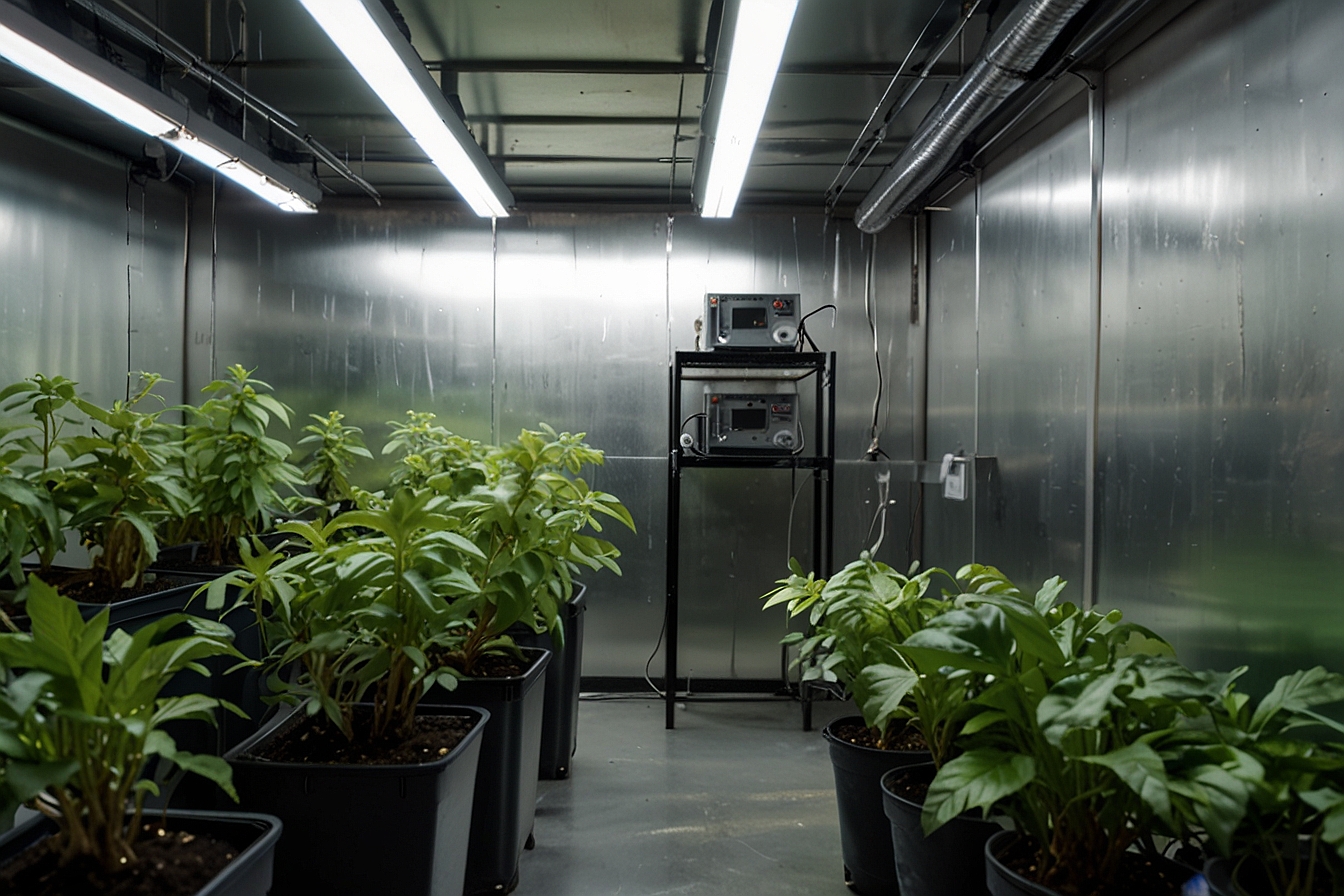
How to Keep a Grow Room Cool
Did you know that ventilation in a grow room is extremely important for your plants? A steady airflow is necessary to refresh the air with a new supply of CO₂, while also keeping the lights and plants cool during hot weather. Without proper ventilation, CO₂ can build up around the plants, and temperatures can rise quickly. In this article, we’ll take a closer look at why proper air circulation is needed, how to set up a ventilation system, and tips to keep your grow room cool during the hot summer months.
Why Air Circulation Is Important
Plants use stomata—tiny openings under their leaves—to “breathe” oxygen and CO₂ depending on the day/night cycle. Over time, these stomata can become blocked by dust, soil, or airborne particles. Outdoors, rain and wind naturally wash and dry leaves while circulating fresh air around them, but in a greenhouse or grow room, you need to replicate this effect using ventilation systems and misting.
Replacing CO₂ and Oxygen
You might think, “Air is everywhere, and this room isn’t hot, so it’s fine.” But that’s not true. Green plants are excellent CO₂ filters—they absorb CO₂ and release it back into the atmosphere. Leaves take in CO₂ and release excess oxygen (during the day). This rapid CO₂ removal must be replenished by air movement. Without circulation, plant growth can be stunted. It’s like trying to breathe after intense exercise—plants cannot absorb enough CO₂ for normal photosynthesis. They can’t produce the sugars they need, so growth slows or stops. In severe cases, larger plants may even drop leaves. Proper air circulation keeps fresh CO₂ moving across the leaves. Remember, you don’t need strong wind—just a gentle breeze to refresh the air in the room.
Controlling Humidity
Air circulation also helps control relative humidity. Indoor grow rooms can generate large amounts of moisture as condensation, especially when it’s cooler outside, making plants more susceptible to pests and mold. Plants themselves release a lot of moisture through transpiration, which can accumulate in a poorly ventilated room. Bringing in fresh air and circulating humid air prevents buildup. Conversely, moving more humid air into a dry room can prevent plants from drying out.
Controlling Temperature
In hot or cold grow rooms, ventilation is the primary method to control temperature. Whether you use a natural (passive) or mechanical (powered) system, you can raise or lower the temperature. Extreme temperatures harm plants, inhibit growth, or even kill them. Each plant has preferred temperature ranges (which can change by growth stage), so planning is essential.
How to Set Up a Greenhouse Ventilation System
The type of ventilation you use depends on where you grow. For outdoor greenhouses, natural ventilation can work. Sloped roofs with vents at the top and bottom are common. An alternative is a powered system using filters and fans. Mechanical systems are almost always necessary for indoor growing, especially with grow tents. Two common types of powered ventilation are INTAKE/EXHAUST and Controlled Environment Agriculture (CEA) systems.
INTAKE/EXHAUST Ventilation
This is the most common and cost-effective method for greenhouses. Intake/Exhaust ventilation uses traditional ducting and inline fans to bring air in and push it out of the grow room. These inline fans are powerful and resemble jet engines (without combustion). Speed controllers allow precise control of airflow and temperature. An Intake/Exhaust setup requires an exhaust fan mounted near the ceiling at one end of the room, with vents or gaps near the floor at the opposite end. The exhaust fan pulls air through the room and expels it outside. The system works even better with two fans—one intake and one exhaust—where the intake draws air from outside instead of relying solely on floor vents. Note: install an air filter to prevent pollen and other pollutants from entering the greenhouse.
IN/OUT Systems for Closed-Light Ventilation
IN/OUT systems also work effectively for closed-light ventilation setups. When HID lights are placed inside sealed hoods, they can become extremely hot and need cooling beyond the greenhouse’s usual requirements. In this case, ducting can be connected directly to the hoods using a simple inline exhaust fan, which pulls air through the light fixtures and across the top to provide cooling.
Note: Always use a fan to pull air out—never push air into the room. Start with one exhaust fan to draw air out of the room, then add another to pull air in from outside.
CEA or “Closed Room” Systems
Inline fans are inexpensive and easy to install, but they can be extremely noisy, even at the highest quality levels. Additionally, the larger the growing area, the more fans you need, which can create a very noisy working environment. No matter how much air you move, hot air from outside will still be warm when brought inside. CEA systems use air conditioning (A/C) to maintain precise temperature control. With a CEA system, you can keep a fully sealed room, completely preventing pollen and outside contaminants from entering.
When installing A/C for a CEA setup, it’s best to use an automatic controller along with a few circulation fans. The automatic controller also allows you to maximize plant growth through differential control.
In a closed room, you should also consider adding CO₂ enrichment, humidifiers, and air filtration to ensure nothing from outside enters your grow space. The size of the air conditioner depends on your grow room’s dimensions. If you’re unsure, consult the retailer. Always choose a unit designed for a space larger than your current room—it’s better to run a larger system part-time than overload a smaller one continuously.
A gentle, continuous breeze is never bad; it mixes the air, replenishes CO₂, and helps regulate temperature. Moving air also deters flying insects by making it harder for them to navigate the room. Either of these systems can accomplish this task, or you can combine both—using A/C to cool the room while inline fans and ducting manage airflow direction and circulation.
Tips for Keeping Your Grow Room Cool
With hot August weather approaching and summer temperatures rising, the risk of excessive heat from lights and poor ventilation can become extremely dangerous for your plants. So what can you do to combat the summer heat? Here are some useful tips to keep your grow room cool.
Air Circulation
Avoid twisting your ductwork. On average, a 90-degree bend causes as much airflow loss as six meters of straight duct. Place intake ducts at floor level on one side of the room and an exhaust fan near the ceiling on the opposite side. This improves air circulation, drawing cooler air from the floor while hot air rises and exits through the ceiling. The goal is to replace all hot air with cooler air—or replace stale air with fresh air.
If it’s still too hot, you can try air conditioning in the room, though this tends to dry the air. You can also cool the incoming air for indirect cooling of the grow room.
Professional Tip: Aim to replace the entire room’s air within five minutes. To calculate the fan needed, multiply the room’s length, width, and height (in feet) and divide by five to get the required CFM (cubic feet per minute). For example, a 10x10x10-foot room has a volume of 1,000 cubic feet. To refresh the air in five minutes, you need a fan with at least 200 CFM. Considering filters and recirculation, a 500 CFM fan will ensure full air exchange in under five minutes.
Lighting
Suppose you already have a perfect ventilation system for your plants, but the room is still too hot. Clearly, the largest source of heat in a grow room comes from the lights. Therefore, if you live in a region with consistently hot weather, it’s best to switch to LED grow lights or fluorescent lights. They produce very little heat, and technological advances have made them almost equivalent to HPS and MH lights. However, if you want to save on initial costs, there are a few other methods you can use.
Run lights at night. Everything is cooler at night, making it much easier to maintain a comfortable temperature. To do this, you’ll need a timer to ensure your plants still receive the proper amount of light each night.
Use fans and a temperature controller. Temperature sensors and controllers can be used to turn on additional fans or even turn off lights entirely if the room’s temperature exceeds the desired threshold.
Use a dimmable ballast. Although this reduces the total light output in the room, dimmable grow lights allow you to control the heat they produce without turning them off completely.
Cool lights with air. Directly cool lights with a dedicated ventilation system. Use sealed hoods for the lights and add ducting to cool the lights directly. Additionally, placing dry ice above the lights can provide extra cooling and supplement CO₂ for the grow room.
Now that you’re familiar with setting up and improving a ventilation system in your grow room, managing heat will no longer be difficult. Remember, improper ventilation and heat from lighting are the biggest issues when it comes to excessive temperatures. For plants, you’ll find that good fans, newer lights, and a few climate-control tips can keep them cool during summer heat. As for yourself, you’ll probably want a tall glass of lemonade while working. Hot days are nothing new, but what do you do to keep your plants cool—or even just keep yourself comfortable—year-round? Is the weather hot enough to worry about? Share your ventilation tips in the comments below!
Click here to find out more about buying LED Grow Lights online