
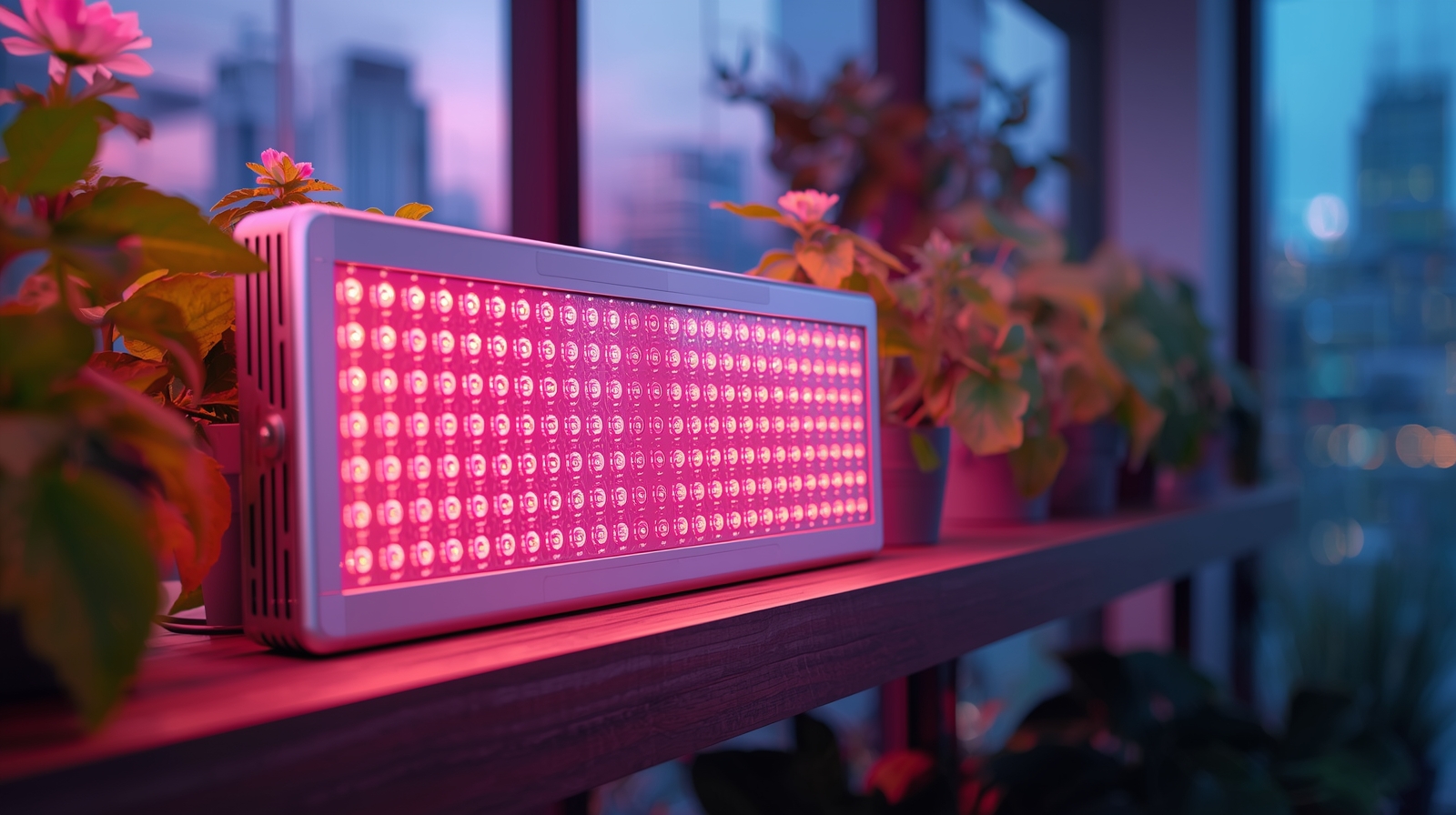
No matter what the weather is like outside, protecting your plants from all kinds of harm has now become much easier. From culinary herbs to leafy vegetables and flowering plants, you can now grow them indoors. This is thanks to modern technology that allows us to provide artificial light for indoor plants. With this guide, you can learn how LED grow lights work and what benefits they offer.
At the same time, you’ll easily find the best UV & IR LED Grow Lights that suit your plants’ needs. There’s no need to search elsewhere—below are the top products that can help keep your plants healthy.
Why should you use LED grow lights?
LED grow lights are energy-efficient. Compared to compact fluorescent lamps (CFL), you get more light for the same amount of electricity. They also emit less heat and have better heat management.
LED lights work best when placed 12 to 18 inches away from your plants. If you use compact fluorescent lamps (CFL), it means you need to find the right height that won’t generate too much heat for your plants.
Currently, LED lights are not the best choice for the flowering stage, as HPS (high-pressure sodium) lights still outperform them in this phase. But with advancing technology, LED manufacturers are beginning to develop LED lighting systems that can perform well during flowering.
It’s only a matter of time before the horticulture industry has LED lights specifically designed for each growth stage.
LEDs may be a bit more expensive up front, but you will reap the benefits later. However, don’t worry too much about the price, as some LED brands are becoming more competitive.
LED grow lights are often plug-and-play devices. This means you don’t need a ballast, and the units are ready to use straight out of the box.
SZHLUX 500W LED Grow Light 4×4/5×5 ft with Timer and Temperature Control, Full-Spectrum Light with 1056 Diodes

Pros:
- EC, ROHS, and UL certified
- Uses PWM dimming
- Provides a large lighting area to increase yields
- Allows full spectrum adjustment to suit the needs of flowers and vegetables
Cons:
- Spectrum penetration may not be effective for some plant types
- Fans are somewhat noisy
See details and prices on Amazon here
ECOHOM LED Grow Light, 500W Indoor Full-Spectrum Grow Light

Pros:
- Produces high-quality plants with better aroma and flavor
- Suitable for both flowering and vegetative growth
- Promotes maximum efficiency and highest yield ratios
- No ballast required
Cons:
- Price is too high compared to competitors
- No separate switch for flowering and vegetative stages
See details and prices on Amazon here
AGLEX K4000 LED Grow Light, Daisy-Chain Dimmable Full-Spectrum Grow Light

Pros:
- Patented compact design with powerful performance
- Incorporates the best and latest technology to enhance indoor plant growth
- Uses less energy and generates less heat
- ETL, RoHS, CE, and FCC certified
Cons:
- Very high price
- Does not allow single-spectrum adjustment for different growth stages
- Cannot be placed too close to plants
See details and prices on Amazon here
What should you look for in an LED grow light?
Power
The first thing you need to consider is the power output that the LED light provides.
When it comes to power, this aspect does not include only wattage but also other specifications such as Photosynthetic Photon Flux (PPF), efficiency, and average Photosynthetic Photon Flux Density (PPFD).
PPF vs. PPFD
PPF refers to the amount of light produced by a source—in this case, the LED grow light—per second, measured in µmol per second.
Now, if you have a growing area of 36 square meters and your plant variety requires about 500 µmol per square meter, you need 1,800 µmol/second of light for that growing area.
Therefore, you will need an LED grow light that produces 1,800 µmol per second. You can use multiple lights together to achieve the necessary PPF.
Note that PPF does not automatically equate to the amount of light that the plants receive; it only measures the amount of light produced by the source.
Meanwhile, PPFD represents how efficiently plants use the photons from the light. You need a fixture that distributes light evenly across the growing area.
If you are running a commercial-scale production facility, you will need a PPFD of about 1,500 to 2,000 µmol/second per square meter, which can be supplemented with CO₂ enrichment systems and other environmental controls.
But if you only have a small growing area, 1,000 will be too much, as it will waste energy—small-scale or personal growers rarely use environmental control systems or CO₂ enrichment.
Lastly, efficiency refers to the amount of photons you can get for the same amount of electrical power consumed.
Light Spectrum
Some LED grow lights are full-spectrum, allowing you to adjust their characteristics to adapt to different growth stages.
Ideally, you should choose full-spectrum LED grow lights that include UV light. This will be more economical because you can use one lighting unit for most, if not all, stages of plant development.
Full-spectrum LED grow lights include red and blue wavelengths, as well as infrared and ultraviolet light. These light colors are essential because they support different stages of growth, stimulating photosynthesis and flowering.
Conclusion
When the best option for keeping your plants alive is to grow them indoors, everything depends on artificial lighting. For example, seedlings need extra care and strong light because insufficient light will make them weak and spindly. Even if you place them on windowsills with the most sunlight, it still might not be enough. Whatever type of indoor plants you have, there are many brands and LED grow lights to choose from. Some may be too strong while others may not provide enough light, so be sure to read each product’s specifications carefully.
See more: How many plants can you grow with a 300W LED grow light?