
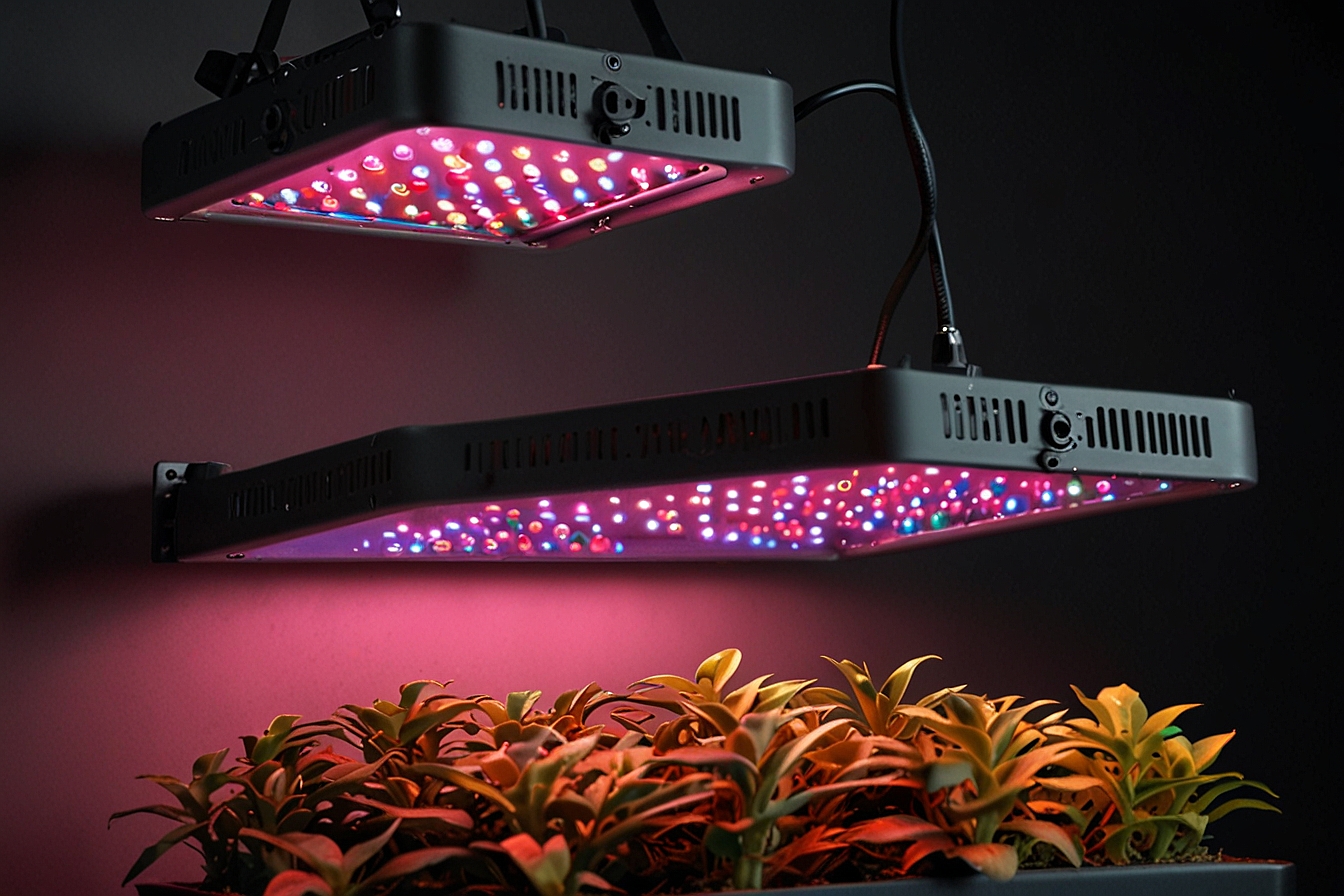
LED grow lights are relatively new products in the world of indoor gardening, but they offer several major advantages over the traditional grow lights people have long used.
The first major advantage is that LED lights operate much cooler than older types of grow lights. Although plants need a certain amount of heat to survive and grow, traditional lights give off far more heat than plants can absorb. This results in wasted energy.
With LED lights, you produce only the light that plants need without generating excess heat, making them far more efficient.
As a result, LED lights are also much more energy-efficient. If you use traditional grow lights that constantly waste energy in the form of heat, you are essentially using electricity for no benefit. For this reason, LED lights can be a worthwhile investment because they can help you save on electricity costs.
They also have another distinct advantage.
Light is emitted at many different wavelengths, but not all light is useful for plants. The parts of the spectrum that are especially important for plant growth are red and blue wavelengths.
With many modern LED grow lights, they are specifically designed to emit the maximum amount of light precisely at these wavelengths, essentially tailoring the light to meet plants’ needs.
With conventional grow lights, this is not possible, and plants can only absorb what they can from the full spectrum without being provided with a specialized “diet” of red and blue light.
What does full-spectrum LED grow light mean?
The term “full spectrum” refers to the wavelengths of a grow light—the colors of light that plants need to successfully perform photosynthesis.
Photosynthesis is the process plants use to convert light into energy for growth. Each type of plant is different, so full-spectrum light provides wavelengths ranging from 390 to 700 nanomoles.
Light spectrum
There are two light spectra you should become familiar with:
Absorption spectrum: These are wavelengths of light that plants can easily absorb and use.
Action spectrum: This spectrum is extremely effective for photosynthesis and helps enhance plant performance.
Full-spectrum grow lights cover all the light spectra that plants need to grow. They can cover the absorption spectrum and control the ratio of wavelengths within the action spectrum.
The light produced includes everything your plants need to grow. One of the key benefits of full-spectrum lighting is that it produces only the types of light your plants will use for growth and does not waste energy producing useless forms of light, helping you save on electricity costs.
The perfect spectrum
Many growers want to achieve the “perfect” light wavelength spectrum for their plants, but this concept does not truly exist.
Full-spectrum light provides all the main color ranges within the PAR (photosynthetically active radiation) spectrum, which includes wavelengths from 390 to 700 nm.
However, the exact wavelengths can vary depending on the manufacturer. The type of LED used also has an impact. Even how you arrange the lighting in the grow room is very important.
Some manufacturers also add infrared and ultraviolet wavelengths to their lighting systems. In addition, some lights are designed for the entire growth cycle, while others only provide light for the vegetative or flowering stages of plant growth.
Reasons to use full-spectrum lighting
Below are three things you should know about full-spectrum grow lights and why you should use them:
- Plants grown under full-spectrum lights grow much larger and are harvested more quickly.
- This light mimics the sun’s ultraviolet rays, making it not only more accessible to plants but also better absorbed by their leaves.
- Unlike other types of grow lights, full-spectrum LED grow lights provide energy comparable to natural sunlight.
Freelicht FLD-1000 LED Grow Light
Pros
- Designed to optimize PAR output – provides the type of light your plants need
- Reflector increases PAR levels – delivers up to 50% higher PAR
- Multiple modes for different growth stages – including vegetative, flowering, and fruiting modes
- Energy-efficient – consumes significantly less power than comparable devices
- Strong safety features – designed to stay cool and be fire-resistant
Cons
- Hanging hooks are not high quality – may bend under the weight
- More blue-spectrum light than red – better suited for the vegetative stage
4-Bulb T5 LED Grow Light and Fixture
Pros
- 5W dual-chip LEDs – brighter and more efficient than 1W or 3W versions
- Energy-efficient – uses up to 30% less energy, significantly reducing electricity bills
- Dual-lens technology – maximizes canopy penetration and increases PAR by up to 200%
- Budget-friendly product – lower price compared to similar alternatives
- Dual cooling fan system – ensures the unit does not overheat
Cons
- Uncertain coverage area – may illuminate a smaller area than some other lights
- Slightly disappointing brightness – appears lower than the power rating stated on the product
DOMMIA Full Spectrum LED Grow Light for Indoor Plants

Pros
- High PAR and deep light penetration – ensures plants receive sufficient light
- Full-spectrum output – suitable for all plant types and all growth stages
- Advanced thermal control system – two powerful fans and a large heat sink
- Bead and Zener design – more efficient than traditional reflector systems
- Affordable price – good value for the quality offered
Cons
- Red light dominates – less effective for the vegetative growth stage
- No “off” switch – the only way to turn it off is to unplug it
See details and prices on Amazon here
Barrina T5 Grow Lights, Full Spectrum, 2ft 80W

Pros
- No reflectors – reflectors can melt, so this model does not use them
- Full-spectrum lighting – includes blue, red, infrared, and ultraviolet light
- Vegetative and flowering modes – can be set according to plant growth stages
- Quiet dual-fan operation – two fans work together to keep the unit cool
- Wide coverage area
Cons
- Fans are slightly noisy – there are somewhat quieter alternatives available
- Packaging is not very discreet – some users may dislike the large, obvious labeling
See details and prices on Amazon here
Buying Guide
Choosing full-spectrum LED grow lights is a great way to save on operating costs for indoor growing, as well as to reduce heat and noise.
The trade-off is that you need to pay closer attention to the amount of light produced and the spectrum delivered to your plants. Let’s take a look at some key factors to consider when buying full-spectrum LED grow lights.
What is full-spectrum light?
Ideally, full-spectrum light should produce colors of light outside the range visible to the human eye, because plants respond well to UV and IR radiation depending on their stage of growth.
Many low-quality “full-spectrum” light brands overlook this aspect of plant cultivation, which can cause problems for buyers when their plants are halfway through their growth cycle and begin to reach their energy limits.
Lights that offer both vegetative and flowering modes are often a better choice because this issue is taken into account in their design, although there are also many lights with only a single lighting mode that are still capable of producing light within this range.
Power (Watts)
As a result, the wattage listed on LED lights can be misleading. Some advertise “equivalent” wattage compared to HPS lamps, while others display the actual power consumption. Be cautious and read the details carefully.
Two different LED lights both labeled as 700W can have completely different brightness levels, especially depending on the light spectrum and the chips used in the system. The actual power draw is often printed in the fine print on the packaging. As a general rule, LED lights operate at roughly twice the energy efficiency of HPS lighting systems. Some are more efficient, some less, but this is a reasonable estimate.
So, if a light is labeled as 700W but actually only draws around 350W, that figure may make sense. However, if it claims something unrealistic, such as consuming only 150W while being equivalent to 700W, then there is a problem. This does not necessarily mean the light is defective—it is often simply a result of poor or misleading packaging.
Compact and discreet design
One of the main benefits of using LED lights is that they have less impact on electricity bills and the temperature of the growing area. However, when you start using larger and more powerful lights, they can still generate significant heat and noise.
Yes, a 1200W LED light uses far less power than an equivalent HPS light, that is true—but it will still warm the room and may create noticeable noise outside the space, depending on how well it is soundproofed. Your electricity bill will also increase, as these are not small lights.
This is something to consider when designing your grow system and deciding how much to scale up. Don’t be overly ambitious—start small and expand gradually as you become more comfortable.
Lifespan
LED diodes can occasionally fail, but overall, LED systems have a relatively long lifespan compared to other types of lighting—provided they are well built. Problems can occur with LED boards that are not designed to operate for thousands of hours, causing partial failure that reduces the performance of the entire system. Depending on the light, this can also affect the spectrum it produces.
A high-quality full-spectrum LED system should not suffer from these issues, so it’s important to research reviews and see whether this is a problem others have experienced. In some cases, accepting this risk may be worthwhile if you do not plan to use the light for many grow cycles.
A cheap LED panel may not last as long as a more expensive one, but it can still meet your needs for a short period.
Enclosed spaces
The final aspect of full-spectrum LED lights to discuss is their use in small, enclosed growing spaces. The low heat output from their lower power consumption makes them an ideal choice for turning a small cabinet or shelf into a mini greenhouse.
Low-power, quiet-running lights are ideal in this situation, because even LED lights can heat up such small spaces. When set up correctly, these spaces can produce excellent-quality cannabis plants, even if yields are slightly reduced due to limited space.
Even higher-powered LED systems can be managed with better ventilation. Good exhaust and intake fans are extremely helpful in small spaces, both for odor control and for maintaining good air quality.
Don’t assume you don’t need an exhaust system just because you’re using a low-power LED light, but you may be able to reduce airflow if you choose your light carefully.
Conclusion
Full-spectrum lighting is the revolutionary future of indoor growing. The advantages of these lights far outweigh their disadvantages.
If you want your plants to grow vigorously and achieve high yields, then investing in LED lighting is the right choice.
The three full-spectrum lights reviewed in this article are ideal for most grow rooms.
The seven LED grow lights reviewed in this article have all proven to be suitable for most indoor growing spaces.
Simply consider your indoor growing environment so you can optimize the capabilities of full-spectrum lights and maximize your crop yields.
See more: The best LED Grow Lights at the US’s Cheapest Prices in 2026